
Raising Awareness, Part 2
Do you know what is the most powerful component on your vehicle? Here are some tips on how to raise your conscious use of it.

Quick question: What’s the most powerful hardware component of your motorcycle?
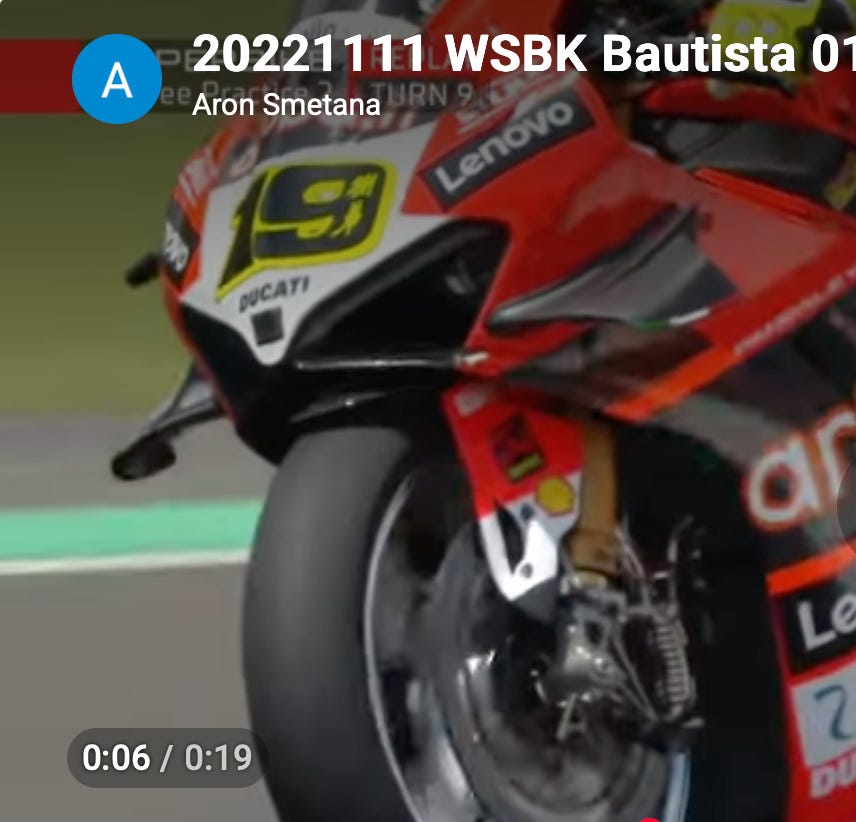
Funny, I think Ken Hill and I were having similar thoughts at the same time. Ken has an excellent post regarding braking drills/exercises. I’m going to take a slightly different approach here as my emphasis is building awareness of how you use the brakes.
It doesn’t matter if you’re on a Panigale V4R or an R3, the most powerful hardware component is the braking system. It takes less time and distance to come to a stop from a given speed than it does to accelerate to that speed (this applies to production bikes built in the last many decades). Twisting the throttle on a bike is mostly uniform in the way that it’s done, however braking technique can vary dramatically based on the type of corner or situation you are approaching. This post isn’t about what types of corners should have different types of braking graphs, but this is about the exercises I use to make myself more aware of my specific use of the brakes. By becoming consciously aware while commuting or on a leisurely ride or drive (and practice regularly), it will lead to greater awareness when at pace on a racetrack.
My commute is 2.1 miles each way. In this commute, I have 7 traffic lights and my little town has no concept of timing the lights so invariably I end up with a lot of opportunities to practice my braking awareness.
What I’ll do, and try to do for every stop at every light for at least a couple of days, is to pick one type of brake graph for that period. I even have sticky notes that I’ll attach to my dashboard as a reminder.
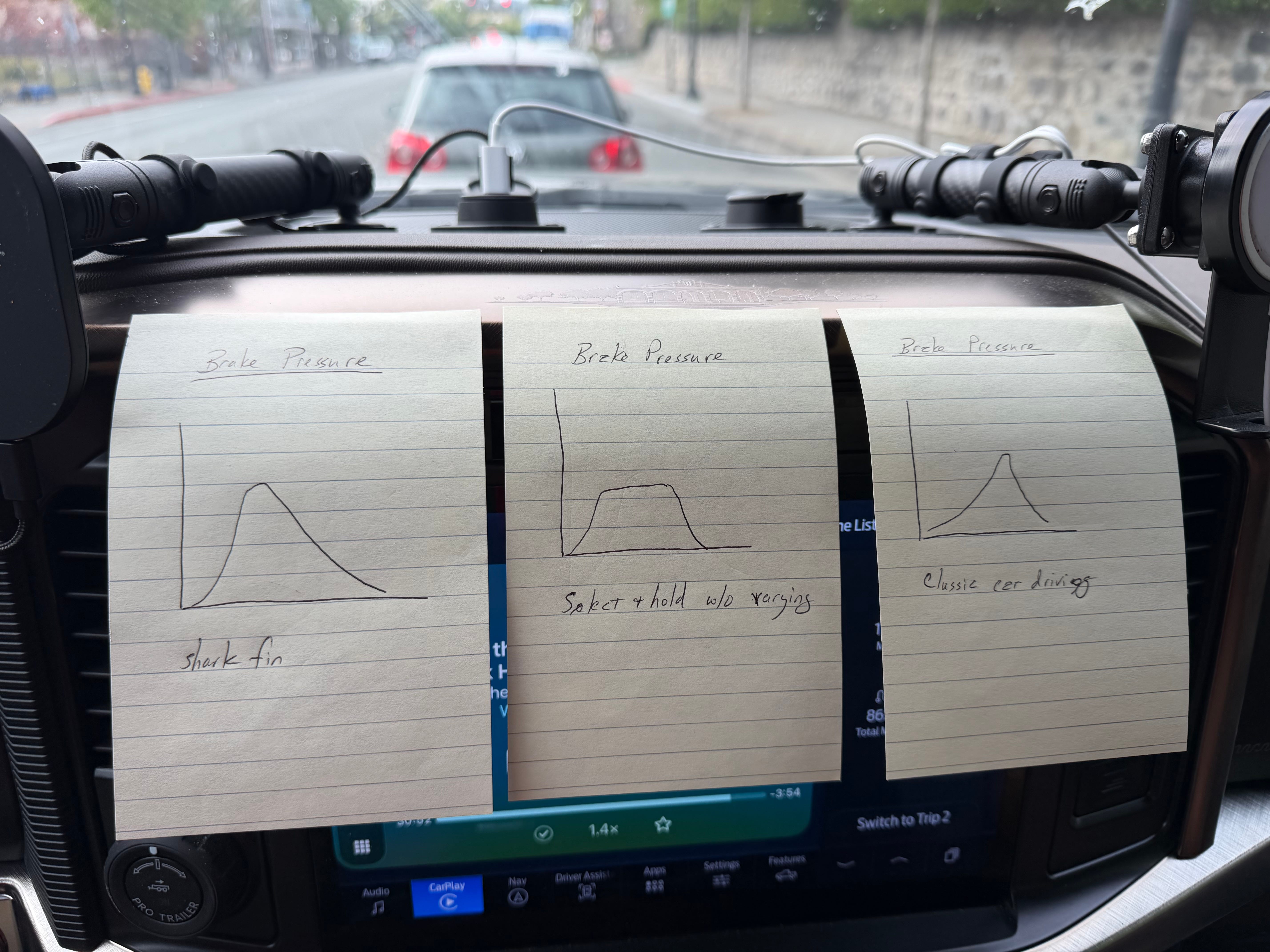
Before we go any further with these exercises, if you do this on a public roadway, pay attention to traffic around you, particularly directly in front of and behind you. None of this actually requires any hard braking or high speeds, this can all be done at completely legal city speeds. All the same, do this at your own risk and comfort.
Here’s what I suggest if you’ve never tried this before: Use the brakes in your commute or leisure ride the way you normally do but in addition to just doing it, pay real attention to how you use the brakes. What I suspect you’ll find is a brake graph similar to the one below:
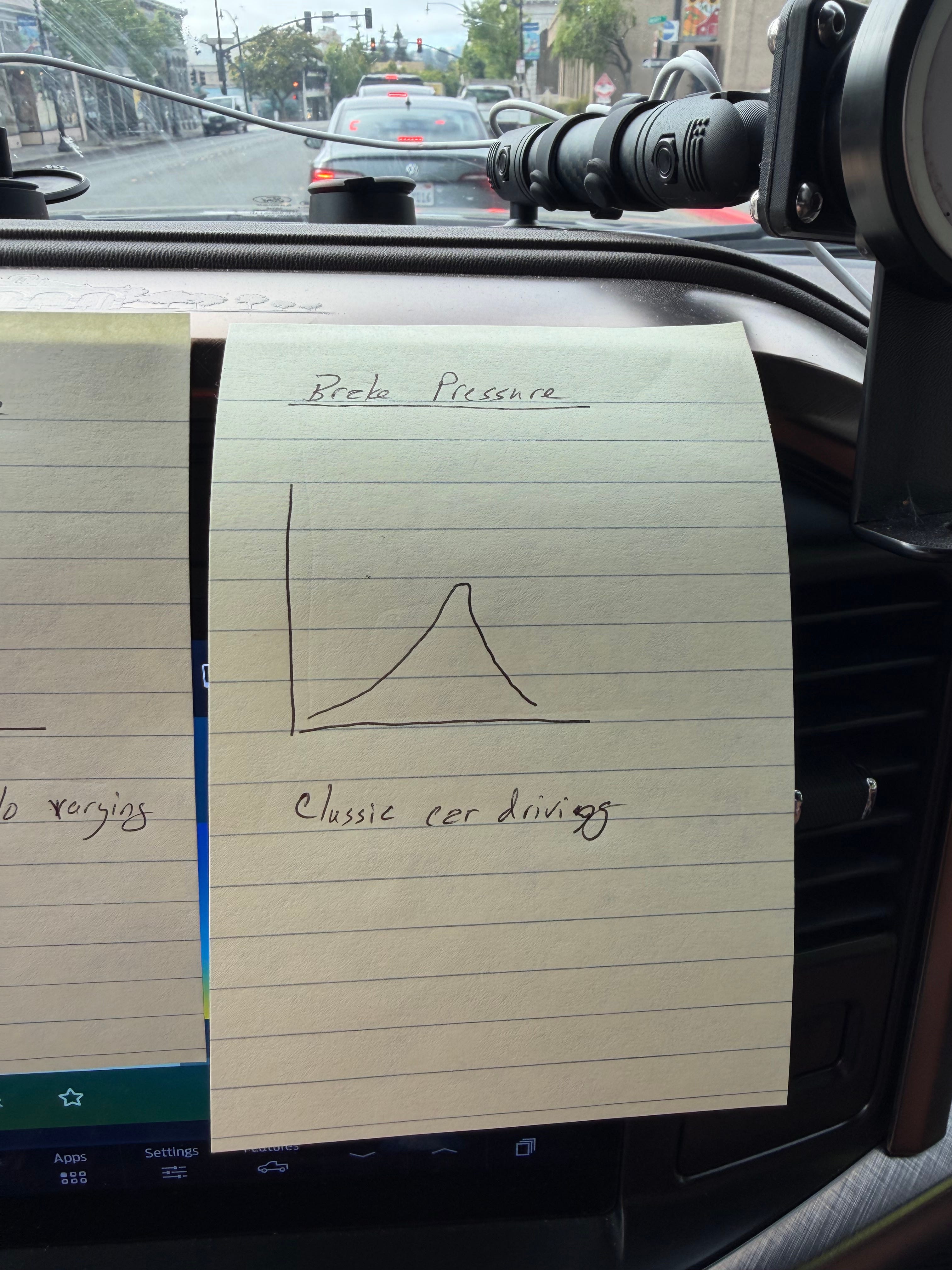
In the above type of brake graph, I think this is what most of us do intuitively to create a smooth ride for our passengers and the contents of our vehicles. In exaggerated circumstances, say the vehicle in front of us comes to a sudden slow-down, it can become rather abrupt when extra brake pressure is required and your contents fly forward and/or your passengers bend forward at the waist or their seat belts lock up.
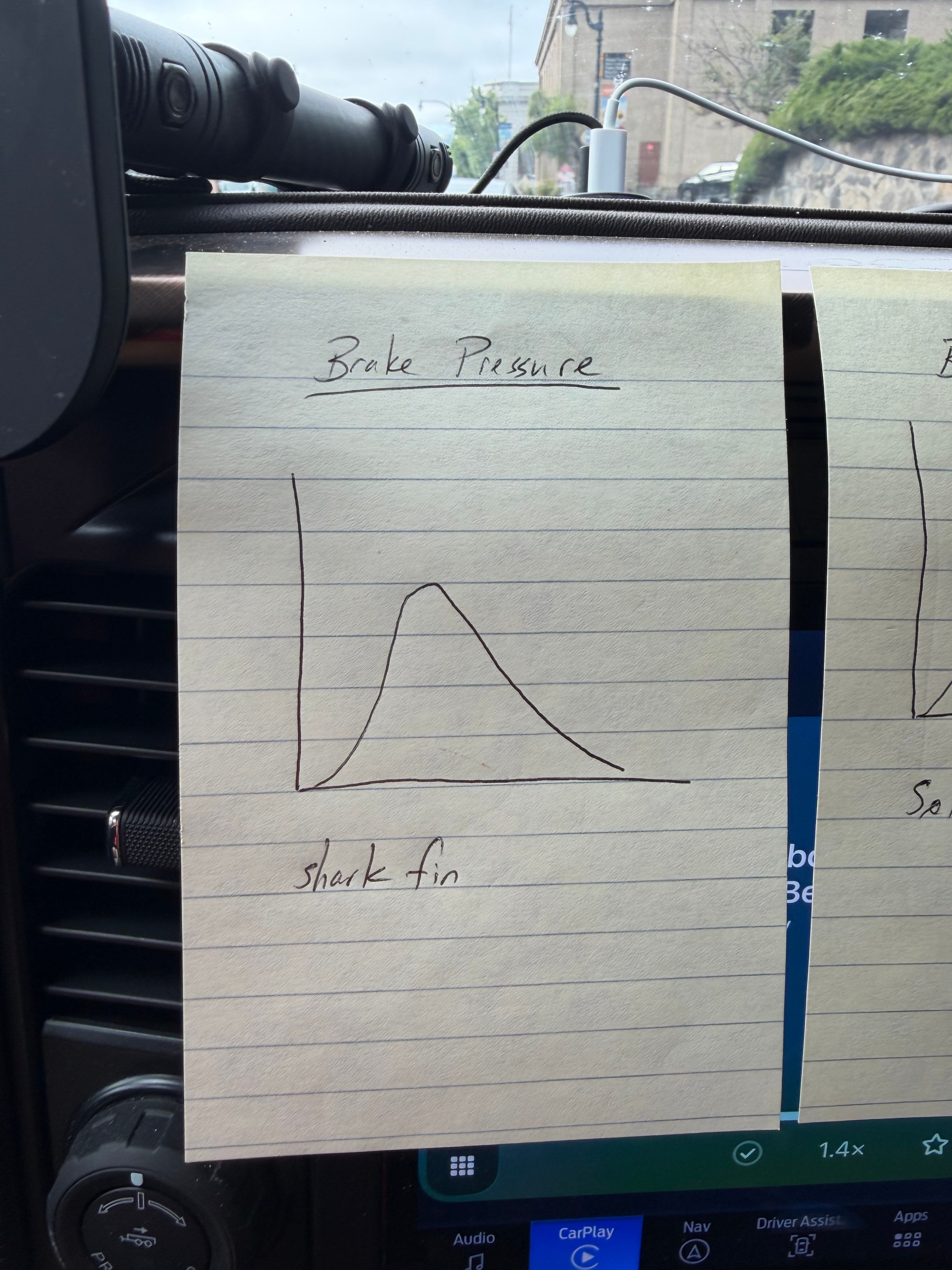
If you’ve been around motorsports a while or read or listen to reasonably reputable sources, you’ve almost certainly heard of the ‘shark fin’ brake graph. In the shark fin style of braking, you’ll see a rapid rise in brake pressure and a gradual tapering off of pressure until full brake release. Again, be conscious of any following vehicles and give yourself extra space to slow down appropriately.
The last exercise is one that, in my opinion, takes more skill and builds awareness of your braking more than any of the others. This is to visually identify your stopping point and build up to enough brake pressure somewhat quickly to bring the vehicle to a complete stop without modulating brake pressure (adding or reducing brake pressure through the braking zone). You can do this with less initial but constant pressure if you start braking earlier, then you can mix it up by braking slightly later with more brake pressure so there are variations on this exercise. This is my favorite and because it requires more active engagement of your eyes and brain, I feel that it raises awareness more than the others.
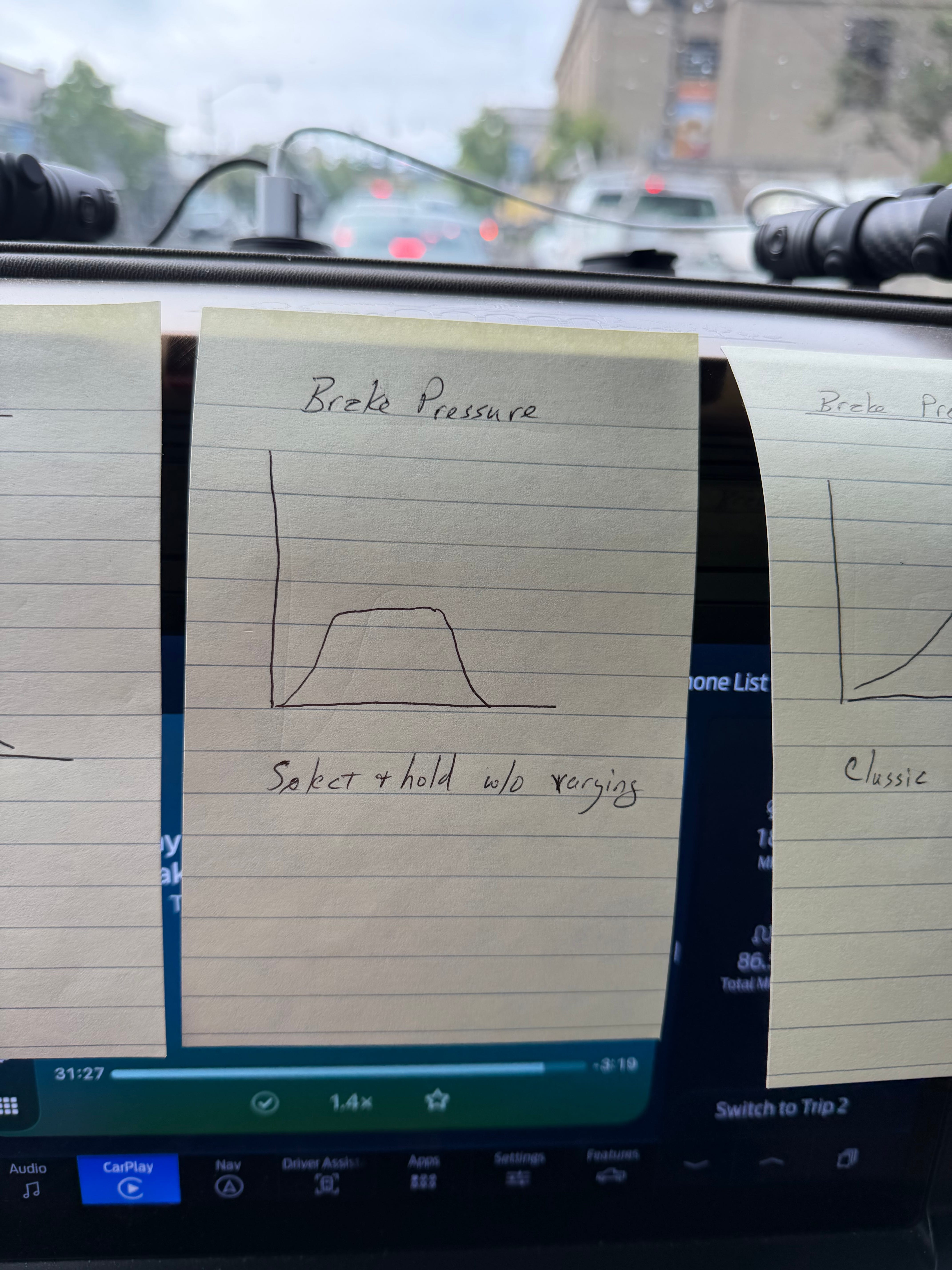
With all of these, we want to visualize the initial braking point before we arrive to it and the brake release (or complete stop) point ahead of time.
Again, these are simple exercises that you can do at any time on your regular drive or leisurely ride but to bring it to a conscious level that you can take with you to the track, you need to do it repeatedly. It’s also a perishable skill (like most) so if you don’t practice again on a fairly regular basis, you may lose some of the conscious behavior. Simply programming your mind to be aware of how you use the brakes will put you in a better place to be able to effectively use the brakes at a much higher track pace. It’s also made me more conscious of how I drive on public roadways as well.
For extra credit, find an empty stretch of reasonably clean roadway and practice from a higher speed. If you have a willing partner or friend, bring them along and ask them for their opinion of whether or not you are achieving the desired braking graph.
Becoming aware in low-stress circumstances and practicing regularly will make it easier to bring your awareness and skills into play in much faster environments.